
By Dorothy Musyoka
Kenya has signed new international carbon market agreements and issued a warning over potentially erratic long rains expected in 2026, as government officials and development partners convened in Nairobi to align priorities on environment, climate change and forestry programmes.
The developments were announced during the 9th Joint Sector Working Group on Environment, Climate Change and Forestry meeting.
The forum brought together officials from the Ministry of Environment, Climate Change and Forestry, international agencies and development partners to review progress and coordinate climate initiatives for the year.
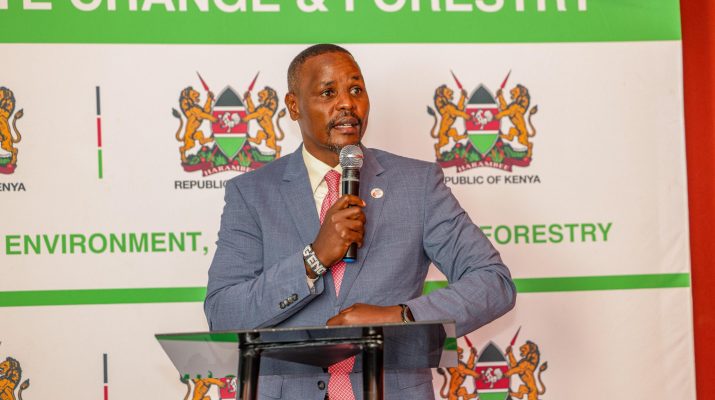
According to Principal Secretary for Environment and Climate Change, Festus Ng’eno, the meeting was aimed at updating stakeholders on key developments and strengthening alignment between partner support and government priorities.
“We must synchronize development partner support with government priorities. This alignment is not optional,” Ng’eno said.
He announced that Kenya has signed bilateral carbon market agreements under Article 6.2 of the Paris Agreement with Switzerland and Sweden, with negotiations ongoing with Singapore and plans to initiate talks with South Korea.
The government, with support from GIZ, is also developing a National Carbon Registry and regulations on carbon trading and non-market approaches to operationalize the country’s carbon market framework.
Kenya is also preparing for the third African Climate Summit in Congo Brazzaville, following the second summit held in Addis Ababa in September 2025.
The meeting reviewed progress on several flagship initiatives, including the 10-year Mau Forest Complex Integrated Conservation and Livelihoods Improvement Programme launched in October 2025 under the “Linda Mau Boresha Maisha” campaign.
Principal Secretary for Forestry, Gitonga Mugambi, underscored the significance of the 15 Billion Tree Growing Initiative, describing it as central to increasing Kenya’s national tree cover to 32 percent by 2032.
Development partners outlined upcoming programmes, including Denmark’s planned 2026–2031 bilateral cooperation, national adaptation planning support from GIZ, a new Global Green Growth Institute programme, and a UNODC roadmap on environmental justice.
Dorian Kivumbi, Co-Chair of the Joint Sector Working Group, emphasized the importance of sustained coordination and results-driven implementation.
“This platform remains critical for aligning investments, strengthening accountability and ensuring that collective efforts translate into measurable climate and environmental outcomes for Kenya,” Kivumbi said.
The discussions focused on improving coordination among stakeholders and ensuring that resources are directed toward tangible climate action and environmental protection outcomes for the country.