
By Dorothy Musyoka
Kenyatta University continues to cement its position as a leading regional hub for advanced radiation protection training following a high-level courtesy call by the International Atomic Energy Agency (IAEA) and the Kenya Nuclear Regulatory Authority (KNRA) to the Vice-Chancellor.
The engagement underscored the University’s growing role in strengthening nuclear and radiation safety capacity across Africa and beyond.
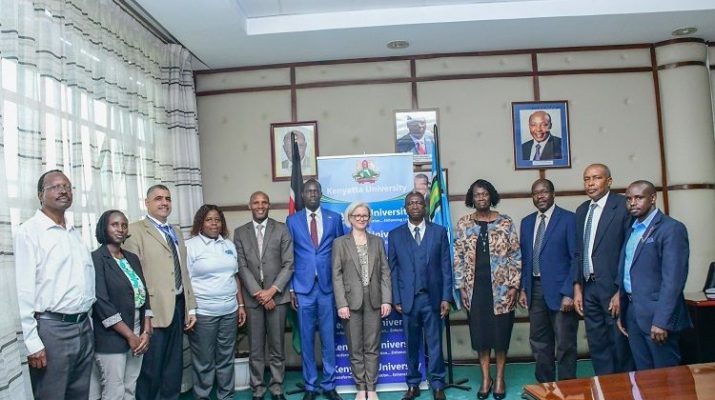
The meeting, held on Wednesday, 28th January 2026 at the Vice-Chancellor’s Boardroom, brought together the University’s senior management, faculty experts, and programme trainers with Ms. Liz Grindrod, Radiation Safety Training Officer at the IAEA, accompanied by Mr. James Keter Chumba, Director General of KNRA.
Discussions focused on the progress, impact, and future expansion of the IAEA Postgraduate Education Course (PGEC) in Radiation Protection and the Safety of Radiation Sources, currently being implemented at Kenyatta University.
The PGEC programme is a flagship IAEA capacity-building initiative offered to Member States to develop a skilled pipeline of professionals capable of serving as regulators, decision-makers, technical experts, and trainers in radiation protection and safety.
The programme responds to the growing global demand for competent oversight in the use of ionising radiation across critical sectors such as healthcare, energy, industry, agriculture, and research.
Kenyatta University hosted the first edition of the programme in Kenya from October 2023 to March 2024, training 17 regional participants who were hosted at the Kenyatta University Conference Centre (KUCC) throughout the course duration.
The success of this inaugural cohort laid a strong foundation for the second edition, which commenced in September 2025 and has attracted 27 participants from across the region reflecting increasing confidence in the University’s training ecosystem.
Participants in the programme come from diverse technical backgrounds, including physics, engineering, nuclear sciences, medical physics, metrology, and environmental sciences.
Beyond classroom instruction, the programme integrates applied learning, regulatory frameworks, safety culture, and international best practice, equipping participants with practical competencies relevant to real-world regulatory environments.
During the engagement, Ms. Grindrod contextualised the programme within the broader global radiation safety landscape, citing comparable capacity-building initiatives in countries such as Nigeria, Uganda, Brazil, Ghana, Egypt, Morocco, South Africa, as well as emerging nuclear jurisdictions in the Middle East and Latin America..
She further noted that the IAEA, working alongside sister United Nations agencies and international technical bodies, continues to promote harmonised safety standards and professional certification pathways for Member States.
In this regard, the PGEC programme is increasingly being positioned not only as an entry-level professional qualification, but also as a foundation for advanced training, refresher modules, and specialised short courses for professionals already working in the field.
Ms. Grindrod commended Kenyatta University for providing an enabling environment for high-level professional training, citing modern facilities, strong institutional support, experienced faculty, and a conducive residential learning setup.
She observed that the current cohort presents an ideal opportunity for the rollout of advanced and follow-on training programmes aimed at strengthening competencies as regulatory demands evolve.
University leadership reaffirmed Kenyatta University’s commitment to deepening collaboration with the IAEA and KNRA.
The discussions highlighted the importance of embedding a stronger research component within future iterations of the programme to support evidence-based regulation and advance the University’s research and innovation agenda.
The meeting also acknowledged cross-cutting challenges, including the need for sustainable funding for advanced training programmes—a concern shared across Member States.
Despite these challenges, all parties expressed strong resolve to accelerate the implementation of additional initiatives under the IAEA–KNRA–Kenyatta University partnership, including potential decentralised programmes to support county-level radiation safety awareness and capacity development.
With full institutional backing and growing international confidence in its delivery capacity, the PGEC programme at Kenyatta University is poised to evolve into a comprehensive regional platform for radiation protection training, research, and professional development.
The partners agreed to commence implementation of the proposed programme enhancements with immediate effect, signalling a shared commitment to strengthening radiation safety governance and professional excellence in the region.